
Why Choose Us?
Quality Assurance
Our products meet the strictest safety standards and have undergone rigorous testing to ensure the highest quality.
Competitive Pricing
We offer competitive pricing without compromising on quality.
Customer Service
We provide excellent customer service with a dedicated team to offer support and answer any questions.
Fast Delivery
We offer fast and efficient delivery of our products.
Rich Experience
We have years of experience in the industry and have built a reputation for reliability and quality.
Wide Product Range
We offer a wide range of products to meet the needs of various industries and applications.
What is Webbing?
Webbing is a woven material commonly made of nylon or polyester fibers. It is widely used for various applications such as creating straps, belts, ropes, and other forms of ties or bindings. Webbing is also used in the manufacturing of outdoor gear, bags, and other textile products. Its strength and durability make it a popular choice for any industry where safety and reliability are essential. Additionally, webbing typically comes in a variety of colors and designs, making it aesthetically appealing for various purposes.
-

White Webbing
Type:Safety Belt. Material:Polyester. Point Type:Other. Size:according to you need. Add to Inquiry -
1.5 Inch Nylon Webbing
Type:Safety Belt. Material:Polyester. Point Type:Other. Size:according to you need. Add to Inquiry -
Webbing Nylon Strap
Belt Material:Polyester. Size:2 Ratchet Tie Down webbing. Capacity:MBL3000~10000kgs. Place of Add to Inquiry -
Orange Nylon Webbing
Type:Safety Belt. Material:Polyester. Point Type:Other. Size:according to you need. Add to Inquiry -
Heavy Duty Nylon Belts
Type:Safety Belt. Material:Polyester. Point Type:Other. Size:according to you need. Add to Inquiry -
Custom Nylon Straps
Belt Material:Polyester. Size:2 Ratchet Tie Down webbing. Capacity:MBL3000~10000kgs. Place of Add to Inquiry -
Webbing Car Seat Belt
Type:Safety Belt. Material:Polyester. Point Type:Other. Size:according to you need. Add to Inquiry -
Custom Seat Belt Webbing
Belt Material:Polyester. Size:2 Ratchet Tie Down webbing. Capacity:MBL3000~10000kgs. Place of Add to Inquiry -
Polyester Webbing 25mm
Belt Material:Polyester. Size:2 Ratchet Tie Down webbing. Capacity:MBL3000~10000kgs. Place of Add to Inquiry -
Custom Webbing Straps
Belt Material:Polyester. Size:2 Ratchet Tie Down webbing. Capacity:MBL3000~10000kgs. Place of Add to Inquiry -
Heavy Duty Nylon Webbing
Belt Material:Polyester. Size:2 Ratchet Tie Down webbing. Capacity:MBL3000~10000kgs. Place of Add to Inquiry -
Polyester Lashing Webbing
Belt Material:Polyester. Size:2 Ratchet Tie Down webbing. Capacity:MBL3000~10000kgs. Place of Add to Inquiry
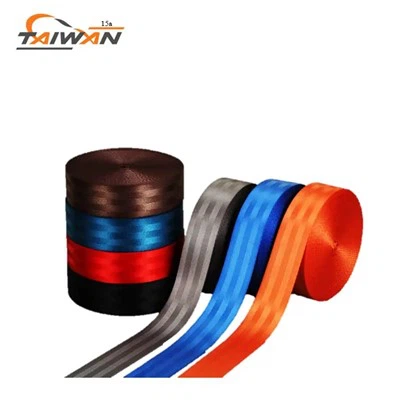


precautions for product use
01/
Advantages of Webbing
These advantages make Webbing a popular choice for a wide range of applications, including outdoor gear, industrial lifting and rigging, military and tactical equipment, and more, where strength, durability, and reliability are essential.
02/
High Strength
Webbing is exceptionally strong, often boasting a higher tensile strength than steel on a weight-for-weight basis. This makes it an excellent choice for applications where strength is crucial, such as in load-bearing straps and harnesses.
03/
Lightweight
Despite its high strength, Webbing is very lightweight. This property is especially beneficial for outdoor enthusiasts, hikers, and climbers who want to reduce the weight of their gear without compromising on durability.
04/
Abrasion Resistance
Webbing is highly resistant to abrasion, making it suitable for use in rugged environments and activities where gear is exposed to rough surfaces. It can withstand repeated friction and wear without degrading quickly.
05/
Low Stretch
Webbing has minimal stretch, which means it maintains its shape and tension even under heavy loads. This property is crucial in applications like climbing, where precise control and safety are essential.
06/
Chemical Resistance
Webbing is resistant to many chemicals, including acids and bases, which makes it suitable for applications in corrosive environments or where exposure to chemicals is a concern.
07/
UV Resistance
Webbing is resistant to ultraviolet (UV) radiation, which prevents it from degrading when exposed to sunlight over extended periods. This property is valuable for outdoor and marine applications.
08/
Flexibility
Webbing remains flexible even in cold temperatures, making it versatile for use in various climates and conditions.
09/
Floatability
Webbing is buoyant, which is beneficial for water-related activities, such as marine applications and water sports.
10/
Durability
Webbing has a long service life due to its resistance to wear, UV exposure, and harsh environments. This durability translates into cost savings over time.
11/
Minimal Water Absorption
Webbing does not absorb water, which helps prevent mold and mildew growth and maintains its performance even when wet.
12/
Low Creep
Webbing exhibits minimal creep, meaning it resists elongation over time when subjected to a constant load.
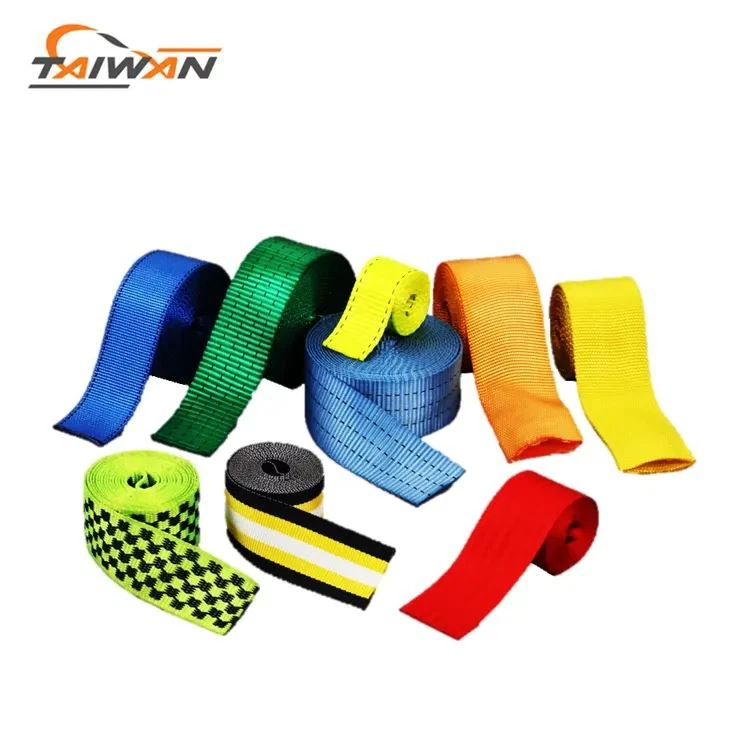
Types of Webbing
Flat Webbing (Or Solid Webbing)
Fibers solidly woven to create flat webbing.
- Properties: Available in different breaking strengths, this style can carry out a number of basic applications. While the flat shape is well suited for applications in which material is sewn directly into a larger product, it can be susceptible to abrasion due to its stiffer nature in comparison to tubular webbing.
Tubular Webbing
Generally thicker, this type of webbing is known to be more flexible than flat webbing.
- Properties: Soft and pliable, this style allows for a variety of uses in comparison to its flat counterpart. It is also less susceptible to wear and tear, and is able to handle dynamic functions, such as holding knots.
Material of Webbing
Nylon
Nylon is very strong and is available in several different types, including nylon 6 and nylon 6,6. It is one of the most commonly used webbing fabrics in the outdoor industry. For this reason, you can easily find nylon in various colors, styles, and applications, including backpack straps and rock climbing safety equipment. It’s a popular choice among rock climbers because of its elasticity and durability. Nylon recovers well, even after extensive stretching. Nylon is also relatively UV-resistant, and as long as you don’t leave it exposed to the sun for months, you will not see much more than 30% loss of strength with nylon 6 and nylon 6,6. The same elasticity that makes it suitable for climbers also makes it a bad choice for hammock suspension. Nylon absorbs water and adds to the weight more than just surface moisture.
Polyester
Polyester is a common choice for webbing in the outdoor industry because it is strong, does not stretch, is UV-stable, and does not absorb water. It also comes in a wide range of widths and strengths. It is about 90% as durable as nylon, and it is one of the most UV-stable webbings available. It is also very resistant to abrasion. These properties make it an excellent choice for hammock suspension and backpack straps.
Polypropylene
Polypropylene is much lighter than other types of webbing fabric and absorbs the least amount of water weight. It floats on the water and is mildew resistant, which might come in handy for some outdoor applications. It also holds up well against stains and damage caused by things like grease and oil. That said, polypropylene is also much weaker than other types of webbing. It has a lower melting point and is less resistant to abrasion than its nylon and polyester counterparts. Polypropylene webbing is a good choice for backpack straps and tarp tie-outs. It’s also suitable for tree straps wider than one inch because it is so low in weight and stretch.
Kevlar
Kevlar has a great weight to strength ratio. It is also abrasion and heat resistant. You may know Kevlar from its use in bulletproof vests, but it has recently become a lightweight tree strap alternative. The downside to Kevlar in the outdoor industry is that it has a very low resistance to UV degradation. With as little as 40 hours in noontime sun, Kevlar can lose up to 50% of its strength. Be cautious when using it for human suspension and avoid exposing it to too much UV light. It is recommended that you use it at night or in the shade, and do not leave it exposed to UV light while in storage. Despite these considerations, Kevlar is very lightweight and packs down very small.
Characteristics of Webbing
Strength and Load-Bearing
Webbings are designed to have high tensile strength, making them suitable for applications where strong and reliable support is required. They can withstand heavy loads and provide stability.
Versatility
Webbings are versatile and find application in various industries. They are used in products such as bags, backpacks, belts, harnesses, safety equipment, pet collars and leashes, military gear, automotive seat belts, and more.
Durability
Webbings are typically made from materials that are resistant to abrasion, UV rays, moisture, and general wear and tear. This makes them suitable for outdoor and rugged environments.
Webbing Patterns
Webbings can come in different patterns, including plain, herringbone, twill, and others. The pattern can affect the appearance, texture, and functionality of the webbing.
Application of Webbing
Safety Equipment
Webbing is utilized for manufacturing safety equipment like harnesses, lanyards, and fall arresters. It is also used to produce slings, ropes, and other lifting equipment in industries like construction and transportation.
Military and Defense
Webbing materials are vital components for producing military equipment for instance, tactical vests, rucksacks, armor plating, and helmets. They are robust and lightweight, making them ideal for a range of applications.
Automotive Industry
Webbing is widely used in the production of car seats and seatbelts, ensuring the occupants' protection during a collision. Car manufacturers also use webbing in AC belt tensioners, airbags and other safety components.
Sports and Leisure
Webbing has multiple applications for producing sports equipment like backpacks, tents, life jackets, and other protective gear for various adventure sports.
Medical Industry
Webbing is utilized to manufacture prosthetic limbs and orthopedic braces. Besides, it is used to add straps to wheelchairs and other medical equipment.
Fashion Industry
Webbing material is also utilized to generate belts, bags, and other fashion accessories due to its durable qualities and the variety of colors and styles available.
What Is the Difference Between Webbing and Tape?
● Both are narrow and elongated materials.
● Both can be made of various materials, such as fabric, plastic, or paper.
● Both are used for binding or securing objects.
● Both have practical applications in various fields, such as construction, manufacturing, or household use.
Similarities >>
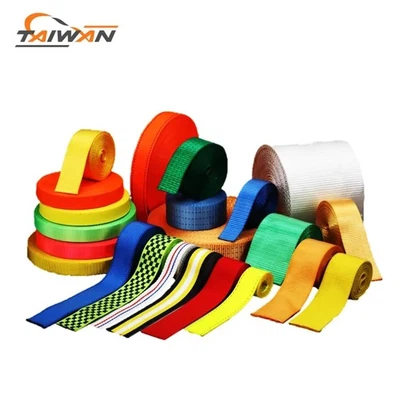

● Function: Webbing is primarily used for strength and support, while tape is mainly used for binding or sealing.
● Width: Webbing is wider than tape and is often used for broader applications, such as straps or harnesses.
● Adhesion: Tape has adhesive properties, while webbing does not.
● Flexibility: Webbing is more flexible and can be bent or shaped, while tape is often rigid and inflexible.
● Usage: Webbing is commonly used in outdoor gear, furniture, and safety equipment, while tape is used in packaging, labeling, and repair.
What Is the Difference? >>
Production Process of Webbing
Woven Webbing
The yarns in the two directions of warp and weft are parallel to the webbing' s length (vertical direction) and webbing' s width (horizontal direction), respectively, and the webbing that is interlaced and combined at right angles is called a woven webbing/flat Webbing. The traditional production method is to use a shuttle loom machine. The weft yarn is placed in a shuttle, and go through the cloth-fell where the upper and lower sets of warp yarns meet to form a webbing with different textures.
When you see this, you will think, huh? Isn't this similar to woven fabric? Yes, the principle of woven fabric is the same. The difference between the two is: In the production process of woven fabric, the weft yarn can be changed according to the needs while the material and color of warp yarn are fxed; but for webbings, the weft yarn is fixed while the warp yarn can be changed according to the pattern. The Shuttleless loom improves the shortcomings of the traditional shuttle loom as a whole. The biggest difference is the change in the way of weft insertion: instead of using the shuttle for weft insertion, other equipment such as Projectile has been used to replace shuttle, and the machine can produce various elastic and non-elastic webbing. At present, the most common types of looms are high-speed shuttleless looms and computer jacquard looms.
Knitted Webbing
Knitted webbing is formed by the interlocking of warp and weft loops. The loops formed by the yarn are intertwined with each other.
Knitting machines includes warp knitting machines, weft knitting (flat knitting) machines and circular knitting machines. The principle is the same as that of hand knitting, except that the knitting needles are operated regularly through the machine, and the looping steps such as hooking and locking are completed by machines to make knitted fabrics. Nowadays, more and more stitches, such as Plain Stich, Purl Stich, Tuck Stich, Miss Stich, etc., have been developed to expand the types of knitted webbing, and the production efficiency has been greatly improved too.
Like the webbing shuttle loom, the webbing knitting machine is smaller than fabric knitting machine. Webbing knitting machine's production efficiency is high and it does not take up space. Circular knitting machine is the most common one. Earloops for facemask, including round or flat earloops can be made by circular knitting machine.
Dyeing Process Of Webbing
1
Acid dyes are mostly suitable for protein fibers, nylon fibers and silk.
It is characterized by bright color, but poor washing degree and excellent dry cleaning degree. It is widely used in natural dead dyeing.
2
Cationic dye , is suitable for acrylic, polyester, nylon and fiber and protein fiber.
It is characterized by bright color, which is very suitable for man-made fibers, but it is used for washing and light fastness of natural cellulose and protein fabrics.
3
Direct dyes are suitable for cellulose fiber fabrics. The washing fastness is relatively poor and the light fastness is different. However, the washing color of the modified direct dyes will be well improved.
4
Disperse dyes, is suitable for viscose, acrylic, nylon, polyester, etc., have different washing fastnesses, polyester is better, and viscose is poor.
5
Azo fuel,is suitable for cellulosic fabrics, with bright colors, and more suitable for gorgeous colors.
6
Reactive dyes are mostly used in cellulose fiber fabrics, and less used in protein.
It is characterized by bright color, light resistance, water washing and good friction resistance.
7
Sulfur dyes are suitable for cellulose fiber fabrics. The color is dark, mainly in navy blue, black and brown. It has excellent light resistance and washing resistance, and poor chlorine bleaching resistance. Long-term storage of the fabric will damage the fiber.
8
Vat dyes are suitable for cellulose fiber fabrics. They have good light fastness and washing degree, and are resistant to chlorine bleaching and other oxidation bleaching.
9
Coating is suitable for all fibers. It is not a dye, but is attached to fibers through resin machinery. Dark fabrics will become hard, but the color registration is very accurate. Most of them have good light resistance and good washing degree, especially medium and Light color.
What are the reasons for the webbing chromatic aberration?
Difference on original material
● The difference between reflected light,
● The material source,
● The material density.
Difference on dyeing process
● The method of dyeing,
● The quality of the dye;
● The horizontal and vertical color difference in the strips between the batch and the confirmed sample,
● The difference in machine precision,
● The color difference between different batches.
Different properties
Cotton webbing and organic cotton webbing and bamboo fiber webbing generally require low temperature dyeing. And polyester webbing and nylon webbing requires high temperature dyeing. The difference in dyeing requirements is also the cause of chromatic aberration.
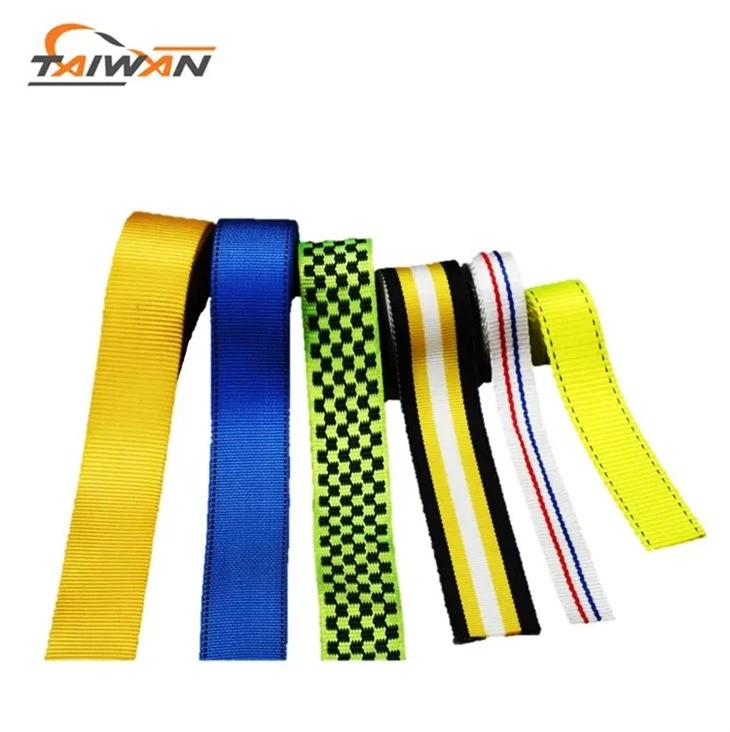
The Considerations for Buying Webbing
Checking the Texture of the High Quality Webbing
We have to see if the texture of the webbing is wrong, and the size of the pattern text is correct. How does each pattern look like compared to the picture? If the pattern is neat, it means that it has already reached the customer’s needs from the graphic.
Checking the Color of the Webbing
We need to carefully observe the color of the webbing and compare the color numbers with the pictures and samples. Checking that whether the dyeing process of the webbing meets the standard requirements. Generally, it can only rely on sensory judgment. However, if there is a high standard for color, there will be a professional color light to match the color.
Checking the Feel of the Webbing
The feel of the webbing is an important method for identifying the quality of the webbing. Specifically, you need to touch the webbing carefully by hand. Due to the different varieties of webbing, the quality is also different, and the feel of the webbing is quite different. The feel has the following aspects:
● Whether the webbing is slack and there is no bending.
● The smoothness and roughness on the surface of webbing;
● The softness and hardness of webbing;
● Thinness and thickness of webbing.
Testing the Environmental Friendliness of the Webbing
The environmental requirements for webbing of different materials are different. We need to test the environmental friendliness of the webbing to meet the customer’s needs in the specialized testing house.
Steps to Clean Your Webbing
Step 1: Check the Care Label
Look at the care label or manufacturer's instructions to see if there are any specific cleaning recommendations or restrictions for your webbing. Follow them if they differ from our general guidelines.
Step 2: Remove the Dirt
Brush off any loose dirt, dust, or debris from the webbing. You can also use a lint roller or tape to pick up small particles.
Step 3: Create the Cleaning Solution
Mix a small amount of mild soap or detergent with lukewarm water in a bowl or sink. The ratio of soap to water depends on the degree of soiling and the size of the strap. Start with a tablespoon of soap per gallon of water and adjust as needed.
Step 4: Apply the Solution
Dip the soft-bristled brush into the soapy water and scrub the webbing in circular or back-and-forth motions. Focus on the areas with visible stains, discoloration, or odor. Avoid saturating the webbing with too much water or soap, as it can take longer to dry and damage the coatings or laminates.
Step 5: Rinse the Webbing
Rinse the webbing with clean water to remove the soap and dirt. You can run it under the tap or use a damp cloth or sponge to wipe away the suds. Make sure to rinse off all the soap residues, as they can cause skin irritation or attract more dirt.
Step 6: Dry the Webbing
Gently pat the webbing with a dry white cloth or towel to absorb the excess water. Avoid rubbing or twisting the strap, as it can cause wrinkles or creases. You can hang the strap to air-dry in a well-ventilated area, away from direct sunlight or heat sources. Avoid using a dryer, iron, or hairdryer, as they can melt, shrink, or burn the webbing.
Step 7: Finish the Webbing
Once the webbing is dry, you can apply a fabric protector to repel water and stains. You can also use a fabric conditioner, such as Febreze, to refresh the scent and texture of the nylon. Follow the product instructions and test on a small, inconspicuous area first.
How to Identify the Polyester Webbing and Nylon Webbing ?
Nylon webbing and polyester webbing have quite similar appearance but different characteristics it’s difficult to distinguish with eyes.
First, detach from several warp and weft yarns from nylon webbing and polyester webbing then mark for them. Then burn to each materials, watching the physical phenomena of nylon webbing and polyester webbing during they are burning, it will help us to determine the material of warp and weft yarns.
Second, be carefully investigate the flame, the melting condition, the smell they give off when burning and wrote them.
After burning to nylon webbing and polyester webbing, we got an report for them as bellow:
Polyester webbing: near flame, droplet and blister to continue burning, a little smoke, very weak sweet taste, hard, round, black or light brown.
Nylon webbing: melting and shrinking near flame, dripping and foaming, not direct continuous combustion, like celery taste hard, round, light, brown to gray, beaded.
Different materials of the webbing, the identification method is different, so we suggest that the best way is identify according to the actual situation .
How to Identify the High Quality Webbing?
1
Checking the texture of the high quality webbing
We have to see if the texture of the webbing is wrong, and the size of the pattern text is correct. How does each pattern look like compared to the picture? If the pattern is neat, it means that it has already reached the customer's needs from the graphic.
2
Checking the color of the webbing
We need to carefully observe the color of the webbing and compare the color numbers with the pictures and samples. Checking that whether the dyeing process of the webbing meets the standard requirements. Generally, it can only rely on sensory judgment. However, if there is a high standard for color, there will be a professional color light to match the color.
3
Checking the feel of the webbing
The feel of the webbing is an important method for identifying the quality of the webbing. Specifically, you need to touch the webbing carefully by hand. Due to the different varieties of webbing, the quality is also different, and the feel of the webbing is quite different. The feel has the following aspects:
● Whether the webbing is slack and there is no bending
● The smoothness and roughness on the surface of webbing
● The softness and hardness of webbing
● Thinness and thickness of webbing
4
Testing the environmental friendliness of the webbing
The environmental requirements for webbing of different materials are different. We need to test the environmental friendliness of the webbing to meet the customer's needs in the specialized testing house.
What Is the Characteristics of 100% Cotton Webbing?
Moisture absorption
Cotton webbing has a good moisture absorption, cotton webbing can absorb moisture into the surrounding atmosphere in normal circumstances, its moisture content is 8-10%, that's why the human feeling the cotton is soft and non-stiff while touch with people skin. If the wet-belt humidity increases and the surrounding temperature is high, the water content will be evaporated, that cause the water of webbing are state of equilibrium, so the people still feel comfortable for cotton webbing .
Moisturizing effect
Because of the cotton webbing is a poor conductor of heat and electricity, it's heat conduction coefficient is extremely low, and because of the cotton tape is porous by itself, high elasticity, there are a large air between of cotton tape, and the air is a poor conductor of heat and electricity, That's why 100% cotton webbing makes people feel warm with its good moisturizing.
Health
Cotton ribbon is natural fiber, its main component is cellulose, and a small amount of waxy substances and nitrogen and pectin. After tested and practiced in many aspects for the 100% cotton webbing, there is no stimulation and negative effective as well as good hygienic properties while wear in a long time touch with skin.
Heat resistance
The cotton webbing has good heat resistance, it will only cause the water of webbing evaporation and not damage cotton fiber while the temperature of 0 degrees Celsius below 110 ℃. There is no change while using ,washing and dyeing for the cotton webbing when in common temperature, thus to improve the durability performance of washable for cotton webbing .
Alkali resistance
Cotton webbing has a greater resistance to alkali, when the cotton webbing stay in alkali solution, without damage to the webbing, the performance not only is good for the washing of pollution, disinfection and removal of impurities, but also for cotton webbing dyeing ,printing and every processes.
Certifications
ISO 9001:2015

Our Factory
Good Success Corp. was established in 1976 in Changhua, Taiwan and has been a specialized manufacturer in car seat belts, Ratchet Tie Downs , Tow Straps , car lashing , sling , webbing , hooks. Occupying a land space of more than 50,000 sq. ft.


Ultimate FAQ Guide to Webbing
Q: What is called webbing?
A: Webbing is a strong fabric woven as a flat strip or tube of varying width and fibres, often used in place of rope. It is a versatile component used in climbing, slacklining, furniture manufacturing, automobile safety, auto racing, towing, parachuting, military apparel, load securing, and many other fields.
Q: What was webbing used for?
A: Many of the products we use every day have webbing straps. Webbing and tape are often used for decorative furniture trim, tie downs, sporting goods, shade edge reinforcement, belts, purses, backpack straps, bag straps, seatbelts, dog collars, parachutes, lanyards, and more.
Q: What is webbing in technology?
A: Webbing delivers secure, reliable and continuous internet connection for devices wherever they are located. Our revolutionary SIM technology, powerful management platforms and robust global network revolutionize your data, making it relevant and actionable.
Q: What is webbing examples?
A: A strong, woven material of hemp, cotton, or jute, in bands of various widths, used for belts, carrying straps, harness, etc. such.
Q: What is human webbing?
A: Webbing of the fingers or toes is called syndactyly. It refers to the connection of 2 or more fingers or toes. Most of the time, the areas are connected only by skin. In rare cases, the bones may fuse together.
Q: Is webbing still used?
A: Of course, the quality, strength, and variety of webbing options has increased considerably over the years! However, it is still used to construct the harnesses, suspension lines, and attachment points that ensure the safe and controlled descent of parachutists and cargo.
Q: What is webbing in the army?
A: Airborne Webbing or Commanders Webbing describes a popular design of load carriage gear that is worn on the person. The type of kit that it holds includes Magazines, Waterbottle, rations, cooker, cord, first aid kit and lots other items depending on what your role is.
Q: What is webbing in manufacturing?
A: The webbing process essentially involves yarns that are woven via looms to create strips. While it is generally comparable to rope for its harnessing function, webbing is an extremely versatile component used in an array of industry applications, ranging from military apparel to automotive parts.
Q: How many types of webbing are there?
A: Webbing is a woven fabric that is available in various materials, strengths and widths. It can be made from materials such as; polyester, nylon, polypropylene, cotton and rubber, with each having specific strengths and purposes.
Q: What is medical webbing?
A: Medical webbing is available in varying thickness and weight categories and is commonly used in items such as arm slings. Other narrow fabrics found in the medical setting such as cubicle curtain header tape are also manufactured at our facility in Philadelphia.
Q: What is webbing and webbing construction?
A: Webbing is actually two separately woven layers which are bound together in various ways. It is the heaviest form of narrow fabrics, ranging from light straps to monster slings used in heavy lifting. The following is a partial list of the most commonly used terms in webbing and production.
Q: What is the softest webbing?
A: Nylon • Polypropylene Any webbing is suitable but you don't need webbing with high strength or UV resistance; nylon will have the softest hand. Polypropylene is another popular choice due to the variety of colors available and economical price.
Q: What is stronger webbing or rope?
A: Tests show static rope is about three times stronger than webbing when pulled down over an edge, and vastly superior when pulled along a sharp edge, as would happen if the master point shifted during a traversing climb.
Q: Which is stronger nylon or polyester webbing?
A: Nylon webbing is preferred for heavy-duty applications, impact resistance, and elasticity, while polyester webbing offers superior UV resistance, color fastness, and low moisture absorbency.
Q: Which is stronger nylon or polypropylene webbing?
A: Nylon webbing is much stronger than polypropylene webbing. Nylon webbing has a tensile strength of 4,200 to 5,500 pound per 1-inch width, while polypropylene only has a tensile strength of 600 pounds per inch. Nylon webbing is also very durable.
Q: What is the best webbing for outdoor use?
A: Polypropylene webbing is ideal for webbing used outside frequently because it has strong UV protection and does not absorb water (preventing mold, rot, and mold). Nylon webbing is a great choice when manufacturers need the highest possible tensile strength. The material is durable and is not known to break or snap.
Q: Is cotton webbing strong?
A: Cotton webbing is an invaluable addition to any household and can be used in a wide range of applications for homeware and furniture making. These include aprons and home textiles, as it is a strong and sturdy material.
Q: Is polypropylene webbing strong?
A: Polypropylene webbing resists degradation from glues and solvents to provide a material that withstands harsh treatment. It is far and away the most common webbing. Nylon webbing became well known during the 1940s to use on a variety of military goods but is not as long lasting and strong as polypropylene materials.
Q: Does webbing shrink?
A: Rattan webbing works best if you give it a soak in the bath for an hour or so prior to using it. This causes it to expand slightly so after you have attached it, it will then shrink back giving you a nice taut area of webbing. Nobody wants saggy webbing!
Q: How should webbing be stored?
A: One good way to store your webbing in your gear pocket is to use a medical glove. This is where we take a piece of webbing in a continuous loop fashion and roll it all the way up into a small straight roll.
As one of the leading webbing suppliers in China, we warmly welcome you to buy or wholesale cheap webbing for sale here from our factory. All customized products are with high quality and competitive price. Contact us for more details.
5 Tonne Ratchet Lashing Straps, Middle Seat Belt Buckle, Epdm Rubber Strap with Steel Hook